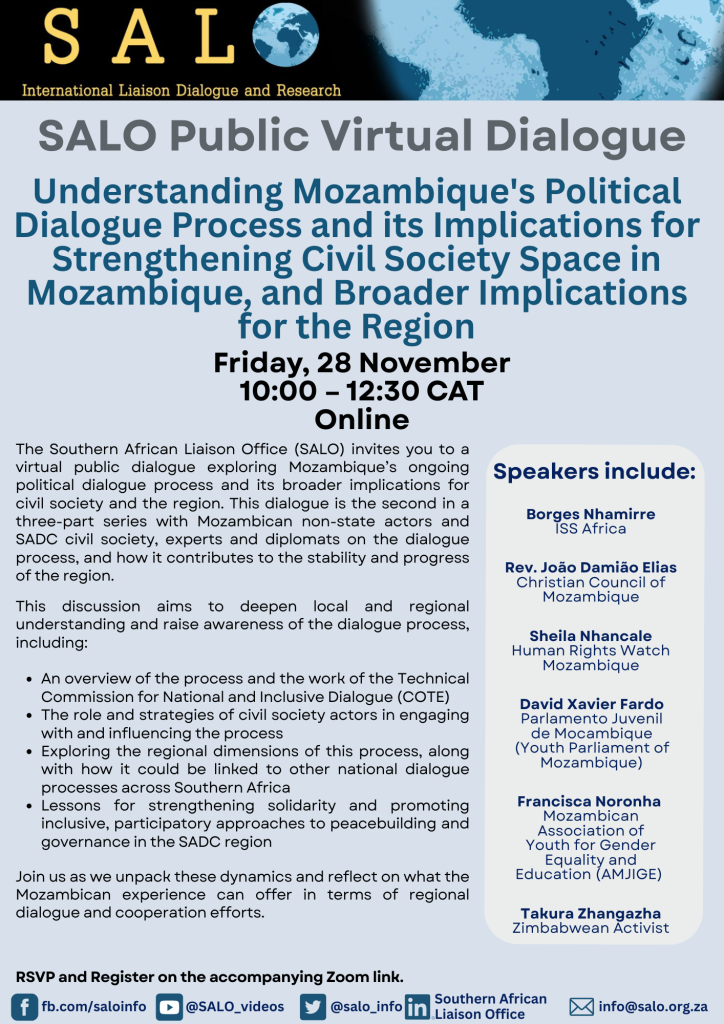

SALO Public Dialogue: Civic Participation, Youth Engagement, and the National Dialogue Process in Mozambique – 28 November 2025
________________________________________
Civic Participation, Youth Engagement, and the National Dialogue Process in Mozambique
On 28 November 2025, the Southern African Liaison Office (SALO) convened a public dialogue examining civic participation within Mozambique’s National and Inclusive Dialogue process, with a particular focus on youth engagement, trust-building, and the role of civil society in shaping reform outcomes.
The dialogue brought together Mozambican civil society organisations, youth leaders, governance practitioners, and regional observers to reflect on how citizens are engaging with the national dialogue process as it unfolds, and to consider the conditions required for meaningful, inclusive participation.
________________________________________
Purpose of the Dialogue
The primary objective of the dialogue was to critically assess how civic participation is being enabled within Mozambique’s National and Inclusive Dialogue process, and whether current engagement mechanisms are responsive to the expectations of citizens, particularly young people.
The discussion aimed to:
• Examine opportunities and constraints facing civil society participation in the dialogue
• Explore youth-led engagement initiatives and their contribution to political legitimacy
• Reflect on the relationship between civic space, trust, and sustainable reform
The dialogue also sought to situate these questions within a broader Southern African context, recognising shared regional challenges related to democratic participation and post-election reform processes.
________________________________________
Key Areas of Discussion
Overview of the National and Inclusive Dialogue Process
Participants reflected on the design and intent of Mozambique’s National and Inclusive Dialogue, recognising it as a significant political response to recent tensions and public dissatisfaction. Contributors noted the importance of the dialogue’s formal structure, while raising questions about how accessible and understandable the process is to ordinary citizens.
Discussion highlighted the need for clearer communication around how public submissions are collected, assessed, and translated into reform proposals, particularly to avoid disengagement or mistrust.
Civil Society Engagement and Influence
The dialogue explored the varied ways in which civil society organisations are engaging with the national process, including direct participation, community consultations, and parallel civic initiatives.
Participants highlighted challenges related to uneven representation, resource constraints, and limited influence over decision-making. At the same time, speakers emphasised the strategic role of civil society in sustaining public scrutiny, amplifying grassroots voices, and holding institutions accountable throughout the dialogue process.
Youth Participation and Political Legitimacy
Youth engagement emerged as a central focus of the dialogue. Participants noted that young people have been at the forefront of recent political mobilisation and continue to face exclusion from formal political processes.
The discussion highlighted youth-led platforms and outreach efforts aimed at gathering citizen perspectives at community level. Contributors stressed that youth participation must be recognised as substantive political engagement rather than symbolic consultation, particularly given the long-term implications of reform outcomes for younger generations.
Civic Space, Rights, and Public Trust
Participants raised concerns about the condition of civic space and its impact on public confidence in the dialogue process. Restrictions on expression, fear of reprisal, and political polarisation were identified as factors that discourage open participation.
The dialogue emphasised that rebuilding trust requires visible commitments to rights protection, transparency, and responsiveness. Without these conditions, contributors warned, dialogue processes risk losing credibility among citizens.
Regional Dimensions and Shared Challenges
The discussion situated Mozambique’s experience within a wider Southern African context marked by contested elections, social mobilisation, and pressures on democratic institutions.
Participants reflected on how civic participation challenges in Mozambique echo broader regional trends, underscoring the value of shared learning and solidarity among civil society actors across the region.
________________________________________
Format and Participation
The dialogue was structured in two parts. The first session featured inputs from invited speakers with expertise in youth engagement, civil society advocacy, and governance reform. The second session provided space for open discussion, allowing participants to share perspectives, raise questions, and engage directly with speakers.
________________________________________
Speakers
The dialogue featured contributions from:
• Bishop Manuel Ernesto, Diocese of Nampula
• David Faro, President, Youth Parliament of Mozambique
• Tebogo Lekubu, Southern African Liaison Office
• Munjodzi Mutandiri, Southern African Liaison Office
_______________________________________
Conclusion
The 28 November dialogue underscored that civic participation—particularly youth engagement—is central to the legitimacy and sustainability of Mozambique’s National and Inclusive Dialogue. While participants acknowledged the political significance of the process, there was strong consensus that its credibility depends on whether citizens see their concerns reflected in decision-making and reform outcomes.
SALO will continue to support informed civic engagement, regional dialogue, and citizen-centred approaches to governance reform in Mozambique and across Southern Africa.