
Virtual Public Dialogue: Understanding Mozambique’s Political Dialogue Process and Its Implications for Strengthening Civil Society Space – 30 Oct 2025
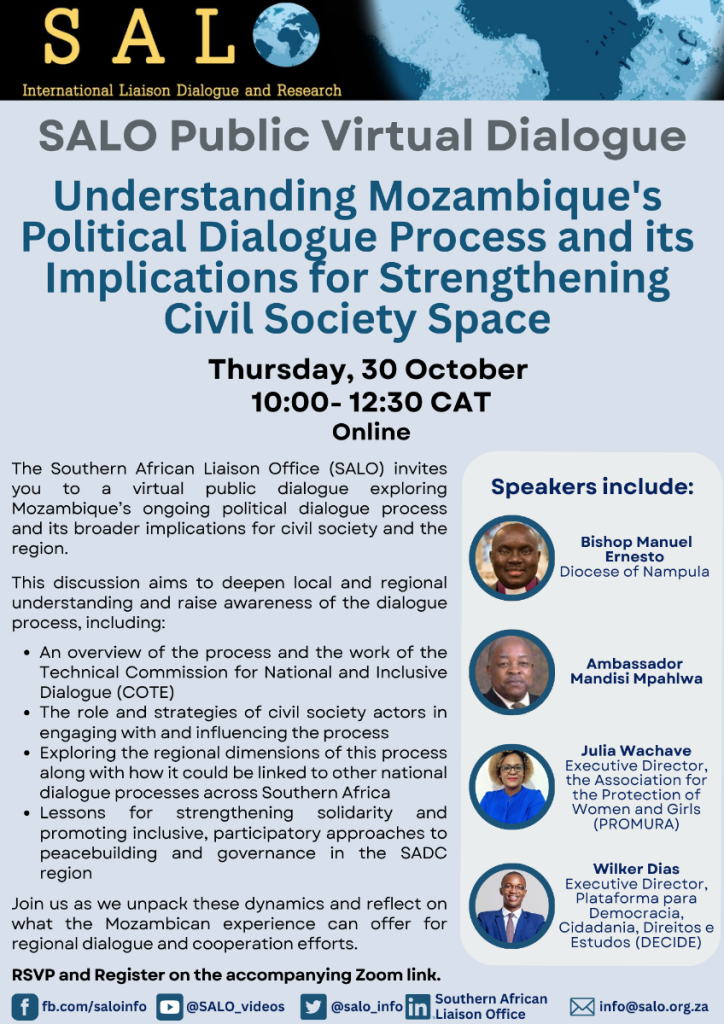
The Southern African Liaison Office (SALO) convened a virtual public dialogue on 30 October 2025 focused on Mozambique’s emerging National and Inclusive Political Dialogue process and its implications for civil society, peacebuilding, and democratic governance.
The dialogue brought together Mozambican civil society leaders, faith-based actors, women’s rights organisations, youth representatives, and regional stakeholders to reflect on the political context giving rise to the dialogue process and to assess its potential to address long-standing governance challenges. Participants also considered how inclusive and participatory approaches could strengthen civic space and contribute to sustainable peace in Mozambique and the broader Southern African region.
Watch full dialogue here:
Purpose of the Dialogue
The primary objective of the dialogue was to deepen understanding of Mozambique’s political dialogue process at a critical early stage, particularly among civil society actors and regional partners. The discussion sought to unpack the origins, structure, and intent of the dialogue, while critically examining the opportunities and constraints facing meaningful civic engagement.
A further aim was to situate Mozambique’s experience within a regional context, drawing out lessons relevant to other Southern African countries grappling with post-election tensions, democratic deficits, and pressures on civic space.
Key Areas of Discussion
Overview of the Political Dialogue Process
Participants examined the origins and design of Mozambique’s National and Inclusive Political Dialogue, including the establishment of the Technical Commission for National and Inclusive Dialogue (COTE). The discussion highlighted the dialogue’s legal and institutional framing, as well as its ambition to move beyond historically narrow, elite-driven political settlements.
At the same time, speakers underscored the complexity of the national context, marked by post-election tensions, insecurity, economic hardship, and public distrust in political institutions. Contributors emphasised that the dialogue must be understood not as a standalone political exercise, but as part of a broader effort to rebuild social cohesion and human security.
Civil Society Engagement and Influence
A central focus of the dialogue was the role of civil society in shaping and influencing the dialogue process. While participants welcomed the formal recognition of civic participation, concerns were raised about uneven access, limited representation, and the risk of symbolic inclusion.
Speakers stressed that civil society engagement must extend beyond consultation to ensure that citizen perspectives – particularly from marginalised and rural communities -meaningfully inform reform proposals. The importance of transparency around decision-making processes and feedback mechanisms was repeatedly emphasised.
Gender, Rights, and Inclusion
The dialogue placed strong emphasis on gender, human rights, and inclusion. Participants highlighted the critical role of women in peacebuilding and community resilience, while noting persistent barriers to women’s meaningful participation in political processes.
Discussions also addressed the protection of vulnerable groups and the safeguarding of civic space, with contributors warning that restrictions on freedom of expression, assembly, and association undermine the credibility of any national dialogue. Ensuring safe and enabling conditions for civic engagement was identified as a prerequisite for legitimacy.
Regional Dimensions and Solidarity
Participants reflected on the regional significance of Mozambique’s political dialogue, noting that similar challenges are playing out across Southern Africa. The discussion highlighted the importance of regional solidarity among civil society actors, faith-based networks, and policy communities in supporting inclusive and accountable dialogue processes.
Mozambique’s experience was seen as offering important insights for the region, particularly regarding the risks of elite capture and the need for sustained civic oversight beyond formal agreements.
Lessons for the SADC Region
Drawing on regional experience, contributors identified recurring lessons for national dialogue processes, including the centrality of inclusion, the need for clear implementation pathways, and the importance of managing public expectations.
Participants cautioned that dialogue processes often falter when political consensus is prioritised over structural reform, and stressed that credibility depends on whether dialogues deliver tangible improvements in governance, accountability, and citizen trust.
Format and Participation
The dialogue was structured in two parts. The first session featured inputs from invited speakers with expertise in peacebuilding, civil society advocacy, and governance. The second session was opened to participants, allowing for interactive discussion, questions, and reflections from a diverse range of stakeholders across Mozambique and the region.
Speakers
The dialogue featured contributions from:
- Bishop Manuel Ernesto, Diocese of Nampula
- Julia Wachave, Executive Director, Association for the Protection of Women and Girls (PROMURA)
- Wilker Dias, Executive Director, Plataforma para Democracia, Cidadania, Direitos e Estudos (DECIDE)
- Rafa Valente Machava, Executive Director, Women, Law and Development Association (MULEIDE)
- Ambassador Mandisi Mpahlwa
Conclusion
The 30 October dialogue highlighted both the promise and fragility of Mozambique’s National and Inclusive Political Dialogue. While participants expressed cautious optimism about the process, there was broad agreement that its success will depend on genuine inclusion, protection of civic space, and the translation of dialogue into meaningful reform.
SALO remains committed to supporting informed, inclusive, and regionally grounded dialogue processes that contribute to peace, democratic governance, and social cohesion in Mozambique and across Southern Africa.