
The Invisible Child: Why Documentation Is More Than a Piece of Paper
Recent debates on migration in South Africa have intensified, evolving into a significant national and regional issue marked by widespread sporadic anti-immigrant protests and the departure of more than 160,000 foreign nationals, according to an AFP tally.[1] While official government reports indicated that the South African government has processed over 72 906 people for repatriation or deportation between 7 June and 14 July. [2] Public discourse has largely centered on undocumented adults, border security, and irregular migration. Yet, amid these debates, one important story has remained largely overlooked: that of the undocumented child.
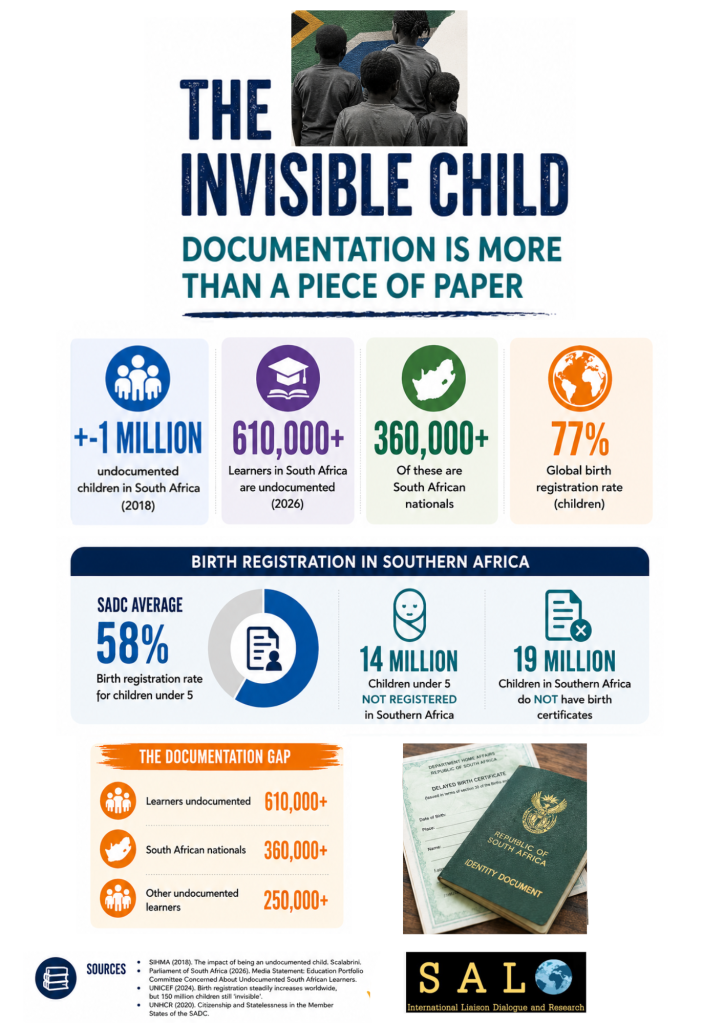
According to a 2018 SIHMA report, nearly one million children in South Africa were undocumented at the time.[3] More recent figures suggest that the challenge remains significant. A recent Parliamentary media statement reported that more than 610,000 learners in South Africa are undocumented.[4] Of these, over 360,000 are South African nationals, highlighting that the country’s documentation challenges extend beyond migrant communities and affect a substantial number of South African children as well.
For these children, the absence of legal identity extends far beyond an administrative challenge. Without official documentation, they are often excluded from government systems and prevented from fully realising the rights and protections guaranteed to them under the constitution. Ensuring that every child is documented is therefore not merely an administrative obligation; it is a fundamental human rights and human security imperative.
This article argues that the lack of legal documentation is one of the greatest barriers to the realisation of children’s rights in Southern Africa. Without birth registration, identity documents, or recognised nationality, children face significant obstacles to accessing education, healthcare, social protection, and legal safeguards, rendering them effectively invisible to state systems.[5] It further argues that xenophobic narratives and increasingly securitised migration debates risk using documentation status as a basis for exclusion, underscoring the need for evidence-based, rights-centred approaches that protect all children.
When a Child Becomes Invisible: The impact on children and why documentation matters.
Every child has the right to a legal identity. Under international law, including treaties to which South Africa is a party, such as the 1989 United Nations Convention on the Rights of the Child, the 1966 International Covenant on Civil and Political Rights, and the 1990 African Charter on the Rights and Welfare of the Child, every child is entitled to a name, a nationality, and immediate birth registration.[6] These protections are reinforced by South Africa’s Constitution, which guarantees every child the right to a name and a nationality from birth, regardless of their nationality or immigration status.[7] Yet, for many children, these rights remain out of reach. Administrative barriers, including stringent birth registration requirements for parents with expired documents or citizens’ blocked identity numbers, leave many children without birth certificates.
Birth registration rates reflect significant global inequalities. While global registration has reached 77%, Sub-Saharan Africa lags somewhat behind. The average birth registration rate for children under five in the Southern African Development Community (SADC) region is 58%, with significant variance between member states.[8]
According to UNICEF (2024), 14 million children under the age of five are not registered in Southern Africa alone, while 19 million do not have birth certificates at all. The absence of this foundational document has far-reaching consequences that extend well beyond childhood.
Without legal documentation, many struggle to access essential services such as healthcare and education and, in some cases, face an increased risk of statelessness, detention, or deportation. Their vulnerability extends even further, exposing them to risks such as human trafficking, sexual exploitation, and child labour.[9] These barriers not only deny children their fundamental rights but also place them among the most vulnerable members of society.
The consequences extend far beyond childhood. Without a birth certificate, a child cannot prove their age, paternity or place of birth, information that is often required to establish nationality and obtain other identity documents. This automatically disenfranchises the individual from their rights. According to the Lawyers for Human Rights Statelessness Unit, during an outreach event held in Orange Farm on 7 July 2026, many parents lacked the documentation, including identity documents, required to register their children’s births, resulting in an intergenerational documentation deficit.[10]
According to UNHCR and UNICEF, a stateless child “can face a lifetime of discrimination,” with profound consequences for their ability to access education, healthcare, and other opportunities. Recognising these challenges, UNHCR’s Global Appeal 2026 commits to supporting governments in reforming nationality laws, strengthening legal safeguards against childhood statelessness, and assisting stateless people in obtaining nationality, legal assistance where necessary, and essential identity documentation.[11]
The Evidence: Principles for effective Messaging
Leveraging from literature monitored, the following may be seen as evidence-based principles that emerge for communicating on migration.
- Lead with common values, not statistics: The Joint Research Centre (JRC) analysis shows that narratives based on universal values (dignity, fairness, and child protection) are more appealing than data-driven appeals. The labelling of undocumented children as “children first” rather than “migrants first” fosters empathy rather than a negative, fearful perception.
- Individual stories within a structural setting can help to humanise: Individual narratives are only effective when contextualised inside systemic constraints that create vulnerability, such as documentation requirements. A child without a birth certificate is not unusual, but rather a foreseeable result of policy design. As such, it can be resolved through policy/legislative amendments.
- Challenge the “illegality” term directly: The Commonwealth Roundtable’s (October 2025) research on media and migration[12]discovered that the term “illegal” when referring to individuals rather than activities is one of the most significant promoters of dehumanisation, and this position is highlighted as a priority in advocacy and policy discussions by SALO. Evidence-based media must emphasise “undocumented” or “irregular” status and clarify that documentation gaps are administrative failings, not moral ones.
- Focus on children’s voices and rights: The Convention on the Rights of the Child establishes a binding legal framework that requires states to register every child promptly after birth (Article 7) and to protect children from all types of discrimination (Article 2)[13]. Messaging based on CRC requirements elevates documentation from a discretionary policy option to a legal necessity.
From Blame to Solutions: How governance can respond more effectively and humanely.
The exclusion experienced by undocumented children is not inevitable; it reflects a gap between South Africa’s legal commitments and their implementation. South African and international legal frameworks place a clear obligation on the state to safeguard the rights of all children, regardless of their documentation status. Through its ratification of international agreements such as the United Nations Convention on the Rights of the Child and the African Charter on the Rights and Welfare of the Child, South Africa and other AU member states have committed to protecting the rights of every child within their borders [14] This commitment includes ensuring access to essential services such as healthcare, education, food, and shelter, irrespective of whether a child possesses official documentation.
Fulfilling these obligations requires more than legal commitments on paper; it demands governance systems that are efficient, accessible, and child-centred. Addressing administrative barriers to documentation is therefore not only a matter of good governance but also a necessary step towards ensuring that every child can fully enjoy the rights guaranteed by law.
National policy must treat identity documentation as a public good and good governance mechanism that safeguards both children and communities. This includes ensuring universal, free birth registration, strengthening legal protections against childhood statelessness, establishing safe and separate registration procedures that do not expose families to immigration enforcement, and guaranteeing access to education and healthcare regardless of documentation status. Furthermore, documentation allows states to appropriately plan and budget for service delivery and development, thus laying the foundations for national developmental planning.
Across the SADC region, these measures should be complemented by targeted public communication, media training, community-led narratives, proactive responses to misinformation, and meaningful engagement with traditional leaders. Together, these approaches can reduce the human and financial costs of exclusion while strengthening social cohesion.
Conclusion
Evidence-based messaging can and must play an important role in tackling the situation. According to research, rights-based narratives focused on children and grounded in universal values are more effective than threat-based frameworks in gaining public support for inclusive policies. Governments are responsible for removing documentation impediments, the media for reporting correctly and humanely, and civil society for holding both parties accountable.
As Pascale Moreau remarked, “Life is stacked against a stateless child from the beginning. They, like all of us, can dream and hope, but the legal barriers they confront frequently mean that their dreams are destroyed before they reach adulthood, and their potential is squandered.”[15] Closing the documentation gap is more than just an administrative reform; it is the foundation for all other rights and the most potent counter-narrative to xenophobia possible.
[1] https://www.france24.com/en/live-news/20260721-south-africa-s-anti-migrant-unrest-led-over-160-000-to-flee
[2] SAnews. (2026). Government scales down Musina repatriation centre. [online] Available at: https://www.sanews.gov.za/south-africa/government-scales-down-musina-repatriation-centre [Accessed 27 July 2026].
[3] commsintern (2018). The impact of being an undocumented child. [online] Scalabrini. Available at: https://www.scalabrini.org.za/the-impact-of-being-an-undocumented-child/ [Accessed 19 July 2026].
[4] Parliament.gov.za. (2026). Media Statement: Education Portfolio Committee Concerned About Undocumented South African Learners – Parliament of South Africa. [online] Available at: https://www.parliament.gov.za/press-releases/media-statement-education-portfolio-committee-concerned-about-undocumented-south-african-learners [Accessed 22 July 2026].
[5] UNICEF. (2024). Birth registration steadily increases worldwide, but 150 million children still ‘invisible’. [Online] Unicef.org. Available at: https://www.unicef.org/press-releases/birth-registration-steadily-increases-worldwide-150-million-children-still-invisible
[6] ScalabriniCT. (2024). Birth Registration in South Africa – Scalabrini. [online] Available at: https://www.scalabrini.org.za/resources/2019-pre-2020/birth-registration-in-south-africa-2/ [Accessed 27 July 2026].
[7] Tamsin Metelerkamp (2026). Watch – The invisible children: South Africa’s late birth registration backlog. [online] Daily Maverick. Available at: https://www.dailymaverick.co.za/video/2026-07-15-watch-the-invisible-children-south-africas-late-birth-registration-backlog/?utm_medium=social&utm_sourcehttps://www.dailymaverick.co.za/video/2026-07-15-watch-the-invisible-children-south-africas-late-birth-registration-backlog/?utm_medium=social&utm_source [Accessed 22 July 2026].
[8] Citizenship and Statelessness in the Member States of the Southern African Development Community (2020). Citizenship and Statelessness in the Member States of the Southern African Development Community. [Online] UNHCR Operational Data Portal (ODP). Available at: https://data.unhcr.org/en/documents/details/84802.
[9] commsintern (2018). The impact of being an undocumented child. [online] Scalabrini. Available at: https://www.scalabrini.org.za/the-impact-of-being-an-undocumented-child/ [Accessed 19 July 2026].
[10] Lawyers For Human Rights, (2026). Facebook post on Orange Farm Outreach. [Online] Available at: https://www.facebook.com/lawyersforhumanrights/posts/-on-7-july-2026-our-statelessness-unit-partnered-with-the-orange-farm-human-righ/1444306721057194/.
[11] Global Appeal, (2026). UNHCR. (2025). [Online] UNHCR. Available at: https://www.unhcr.org/media/global-appeal-2026.
[12] Commonwealth. (2025). 2025 Commonwealth Finance Ministers Meeting (CFMM). [Online] Available at: https://thecommonwealth.org/events/2025-commonwealth-finance-ministers-meeting-cfmm.
[13] United Nations (1989). Convention on the Rights of the Child. [Online] OHCHR. United Nations. Available at: https://www.ohchr.org/en/instruments-mechanisms/instruments/convention-rights-child.
[14] SAnews. (2020). Programme to protect undocumented children. [online] Available at: https://www.sanews.gov.za/south-africa/programme-protect-undocumented-children [Accessed 19 July 2026].
[15] UN News. (2019). UN agencies call for action to bolster rights of Europe’s stateless children. [Online] Available at: https://news.un.org/en/story/2019/02/1032791.