The Gendered Experience of Migration in Southern Africa
Introduction
Across Southern Africa, women, girls, and lesbian, gay, bisexual, transgender, queer and intersex (LGBTQI+) persons are increasingly participating in both internal and cross-border migration. Like all migrants, their movements within and across the region tend to be shaped by a range of factors, including the search for better economic opportunities, political instability, and, increasingly, environmental and climate-related pressures.[1] Importantly, women are increasingly migrating independently as workers, breadwinners, and heads of households, challenging traditional assumptions that women migrate primarily as dependants accompanying male migrants.[2] South Africa occupies an important position within these regional migration patterns as a country of origin, transit, and destination.
While migration can present various opportunities, challenges, and risks, women, girls, and LGBTQI+ persons often experience heightened vulnerabilities throughout the migration process. These risks can occur both during migration and after arrival in destination countries. Many women face gender-based violence, xenophobia, social exclusion, and economic exploitation, while LGBTQI+ persons may experience discrimination, violence, abuse, marginalisation, and threats to their personal safety. These vulnerabilities can be further compounded by factors such as nationality, migration or documentation status, race, socioeconomic position, sexual orientation, and gender identity. The current immigration challenges in South Africa and the Southern African Development Community (SADC) region have further intensified some of these vulnerabilities. Yet, the gendered and intersectional dimensions of migration continue to receive insufficient attention in migration policy and governance.
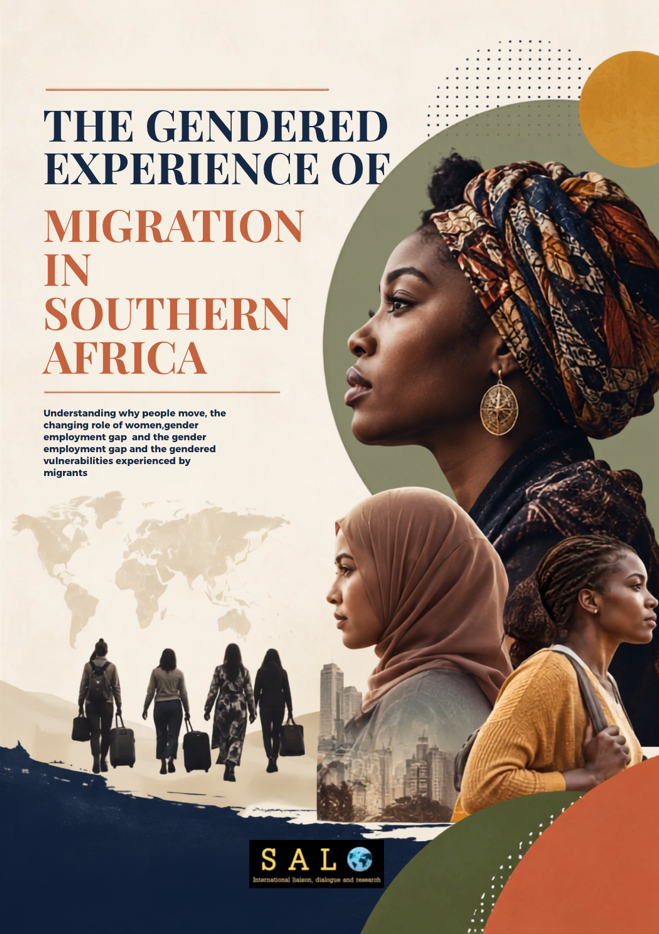
This article considers why people migrate, the changing role of women in migration across Southern Africa, the particular challenges confronting women and LGBTQI+ migrants, and the measures required to strengthen gender-responsive and inclusive migration governance in South Africa and the broader SADC region.
Why do people move?
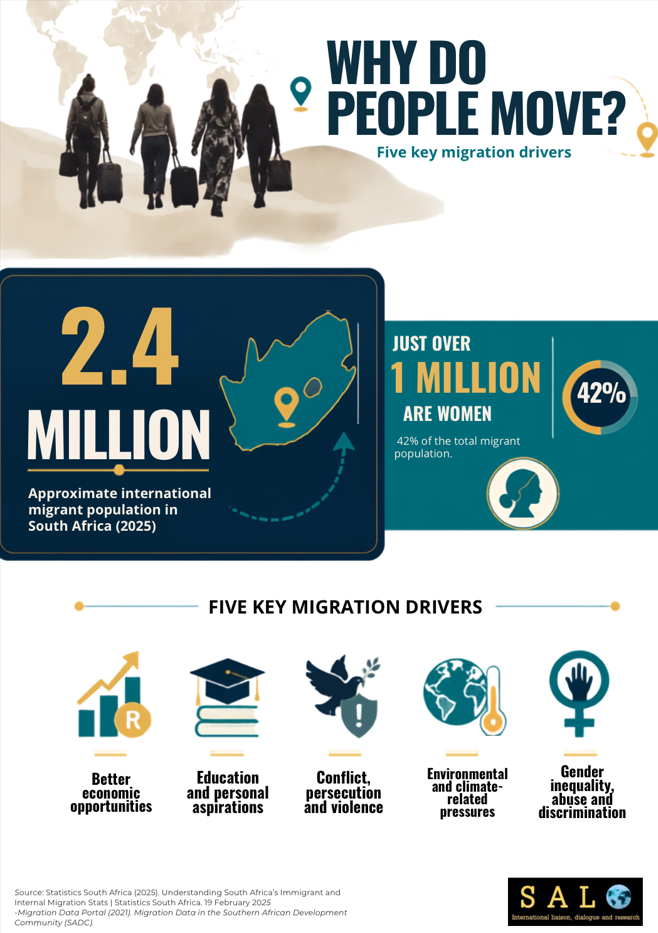
South Africa hosts the largest population of migrant women on the African continent. According to Statistics South Africa (2025), of the approximately 2,4 million international migrants in the country, just over one million are women, accounting for around 42% of the total migrant population.[3] Many originate from neighbouring SADC countries, including Lesotho, Malawi, Mozambique, and Zimbabwe.[4]
While reliable quantitative data on LGBTQI+ migrants in South Africa remain limited, largely due to the challenges these migrants face in accessing services, reporting their experiences, and navigating migration processes, emerging research indicates that they constitute a significant part of the country’s migrant and asylum-seeking population. A survey tool developed by the University of the Witwatersrand provides evidence of the presence of substantial numbers of LGBTI+ migrants and asylum seekers in South Africa, supporting what has long been suspected but has been difficult to quantify.[5]
The decision to migrate is shaped by a range of interconnected factors. While many people move in search of better economic prospects, education, and improved living conditions, others are compelled to leave because of conflict, environmental and climate-related crises, or persistent gender inequality.
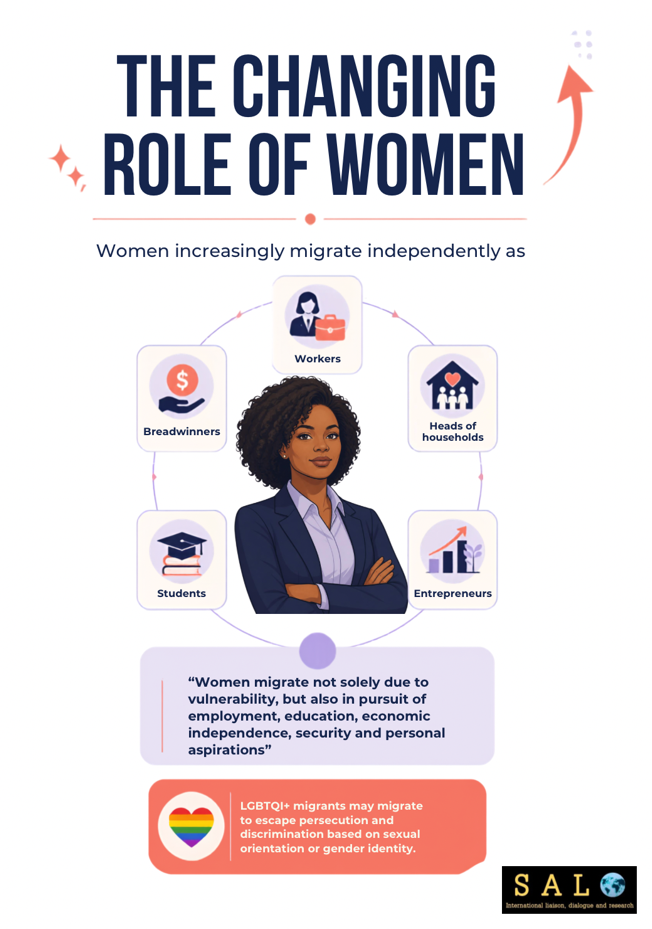
For women, however, migration should not be understood solely as a response to hardship or vulnerability. Women increasingly migrate independently in pursuit of employment, education, economic independence, and personal aspirations. Research on migration within the SADC region has documented a changing pattern in which growing numbers of women migrate independently and as heads of households, with important implications for families, communities, and remittance flows.[6] At the same time, some women migrate to escape gender inequality, domestic and sexual violence, conflict, or persecution. UN Women notes that many migrant women in South Africa have experienced community or political violence, rape, or domestic abuse in their countries of origin. Migration can therefore simultaneously reflect agency, aspiration, and necessity.
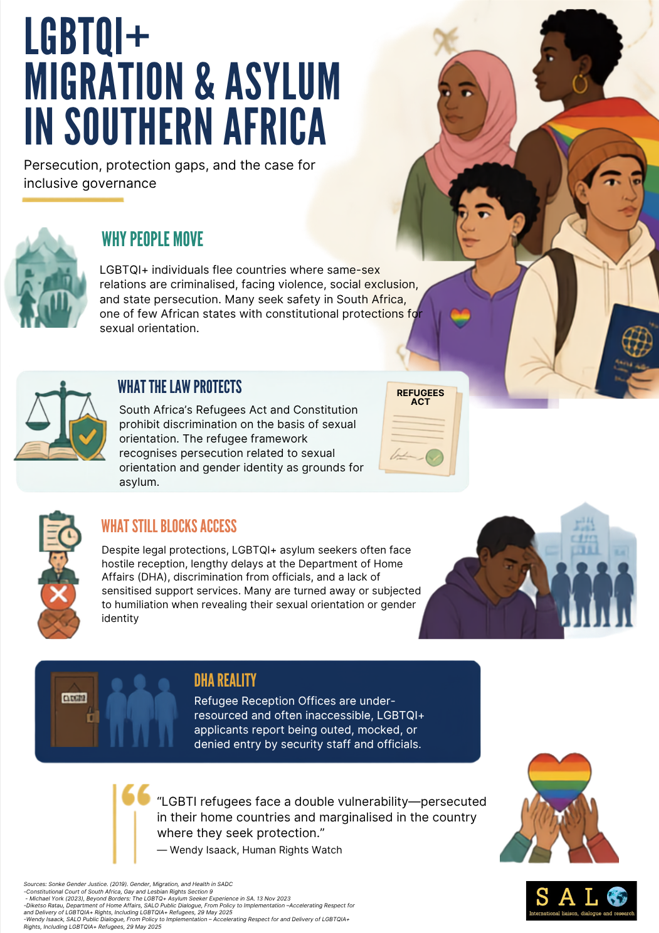
Similarly, some LGBTQI+ migrants flee persecution and discrimination based on their sexual orientation or gender identity, with South Africa often viewed as a potential safe haven.[7] For these migrants, movement may be driven by threats to their safety, criminalisation of same-sex relationships, discriminatory laws, violence, and hostile social environments that remain prevalent in parts of the African continent. South Africa’s constitutional framework is comparatively progressive: Section 9 of the Constitution expressly prohibits unfair discrimination on grounds including gender, sex, and sexual orientation.[8] Its refugee framework also recognises persecution related to sexual orientation and gender identity as grounds for asylum. These legal protections have contributed to South Africa being an important destination for LGBTQI+ people seeking safety and protection.[9]
The Gendered Impact of Migration
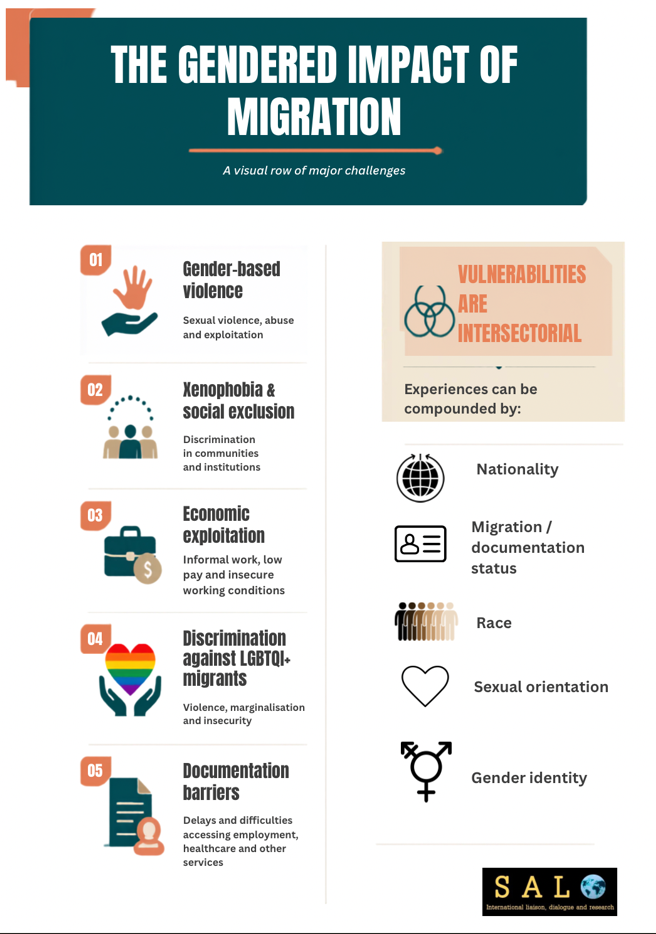
While migration can create opportunities for greater economic independence, security and personal autonomy, migrant women may also experience intersecting vulnerabilities linked to gender, nationality, migration or documentation status, race and socio-economic position. LGBTQI+ migrants and asylum seekers can experience additional discrimination and insecurity associated with sexual orientation and gender identity.
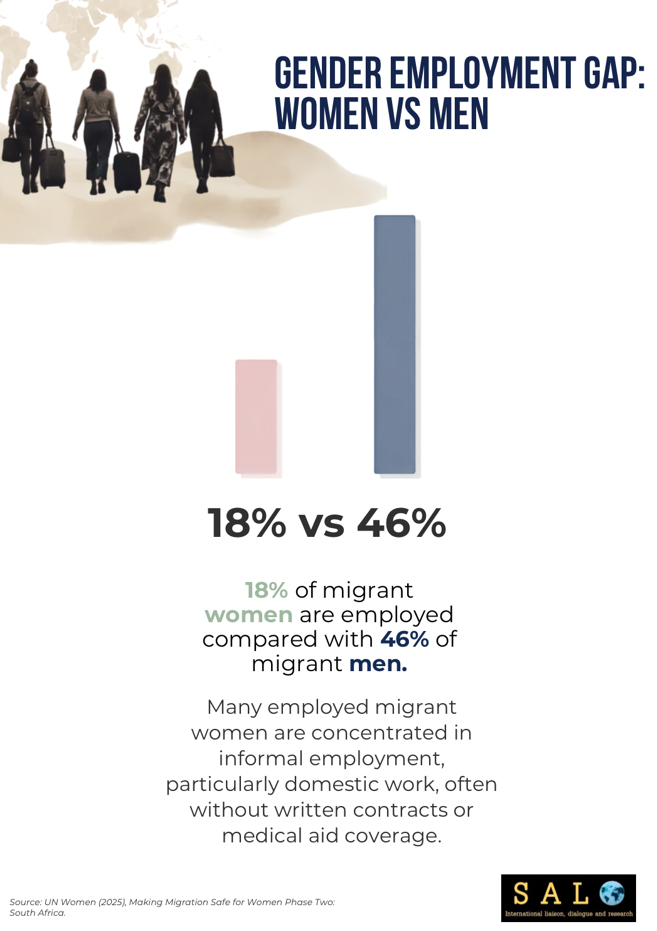
Migrant women in South Africa face difficulties accessing decent and secure employment. UN Women reports that an estimated 18% of migrant women are employed, compared with 46% of migrant men. Many employed migrant women are concentrated in informal employment, particularly domestic work, frequently without written contracts or medical aid coverage.[10] This can increase vulnerability to exploitation and abuse. Gender can also intersect with race, nationality and migration status to create multiple forms of disadvantage. Migrant women may experience sexual and gender-based violence, xenophobia and discrimination in communities and when accessing institutions including schools, courts and hospitals. Limited information about their rights, relevant laws, available services and migration procedures can compound these vulnerabilities.[11] Documentation difficulties can further restrict access to employment, healthcare and other services and increase vulnerability to exploitation. These experiences also differ considerably between groups: the circumstances of a documented professional migrant, an informal cross-border trader, refugee, asylum seeker, undocumented woman, survivor of gender-based violence or woman with a disability cannot be assumed to be the same.
An intersectional perspective must also recognise the experiences of LGBTQI+ migrants and asylum seekers. South Africa’s strong constitutional protections coexist with significant difficulties in translating formal rights into practice. Research has documented barriers experienced by LGBTQI+ asylum seekers in accessing legal protection, essential services and employment, despite South Africa’s comparatively progressive legal framework.[12]
This gap between policy and implementation was acknowledged by Department of Home Affairs (DHA) representative Diketso Ratau during a 2025 SALO dialogue. Ratau noted that, although South Africa’s laws recognise asylum claims based on sexual orientation and gender identity, practical realisation of these rights remains inconsistent. Challenges identified included bias and inadequate understanding among some officials, inconsistent application of guidelines, documentation delays, insufficient training, limited disaggregated data and a lack of dedicated safe spaces. DHA further acknowledged that documentation delays can increase exposure to exploitation, xenophobia, harassment and violence.[13]
Human rights lawyer Wendy Isaack provided a complementary civil society perspective, arguing that many of the difficulties reported by African LGBTQI+ asylum seekers in 2025 closely resemble those reported two decades earlier. She highlighted bias in refugee status determination, inadequate provision of information, lengthy delays and failures to consistently implement existing refugee and administrative law. Isaack further emphasised that LGBTQI+ asylum seekers can experience multiple and overlapping forms of discrimination associated not only with sexual orientation or gender identity, but also with nationality, race and class.[14]
Towards Gender-Responsive Migration Governance
At the continental level, the African Union has developed relatively progressive and migration-aware frameworks, particularly through the AU Revised Migration Policy Framework for Africa and Plan of Action (2018–2030), the AU Maputo Plan of Action (2016–2030) for the operationalisation of the Continental Policy Framework on Sexual and Reproductive Health and Rights, Agenda 2063, and the Common African Position (CAP) on the Global Compact for Safe, Orderly and Regular Migration (GCM).[15] These frameworks recognise the complexity of migration and incorporate issues such as gender, human rights, labour mobility, health, and migrant protection. However, their impact is often limited by a significant gap between policy commitments and implementation.[16] Continental institutions can establish standards, provide guidance, and encourage governments to act, but their ability to ensure that these commitments are translated into concrete action at national and local levels remains limited.
South Africa and the SADC region are likewise not without relevant legal and policy frameworks. At the regional level, these include the SADC Regional Migration Policy Framework and Action Plan, the SADC Protocol on Facilitation of Movement of Persons, the SADC Labour Migration Action Plan, and the SADC Regional Strategy and Framework of Action for Addressing GBV.[17] Despite SADC’s efforts to facilitate the movement of people and strengthen regional integration, migration governance across Southern Africa remains largely fragmented and driven by national interests.[18] Migration continues to be approached primarily through the lens of border control and security, rather than as a shared regional issue that also requires attention to human rights, development, and the protection of migrants.
Furthermore, South Africa has extensive constitutional and refugee-law protections, while regional and international frameworks provide additional standards for protecting migrants’ rights. The challenge is increasingly to translate these commitments into consistent policy implementation and practical protection.
The Global Compact for Safe, Orderly and Regular Migration (GCM) is one relevant international framework in this regard. It establishes gender-responsiveness as a cross-cutting guiding principle and calls for migration governance that considers the different realities faced by women and men throughout the migration cycle, promotes gender equality and the empowerment of women and girls, and addresses intersecting inequalities.[19] The GCM should therefore complement rather than replace national and regional approaches to gender-responsive migration governance.
Recent discussions concerning implementation of the GCM nevertheless illustrate a broader challenge. During consultations on the UN Network on Migration’s 2026-2028 work plan, Women in Migration Network reported that gender-responsiveness was explicitly referenced in only 48% of national progress reports submitted for the 2026 International Migration Review Forum. Participants consequently called for stronger institutional mechanisms, gender-responsive indicators and better national and regional follow-up.[20] This reinforces the wider lesson for South Africa and SADC: formal recognition of gender responsiveness needs to be matched by measurable implementation.
Conclusion
The changing face of migration in Southern Africa requires migration governance that recognises both the agency of women who migrate and the differentiated vulnerabilities that migrants may experience. Women increasingly migrate independently in pursuit of employment, education, security and personal aspirations, while others move in response to violence, persecution, economic hardship or environmental pressures. Gender, however, intersects with migration status, nationality, sexuality, race, disability and class to shape migrants’ experiences during movement and after arrival.
South Africa has important constitutional and legal protections, while regional and international frameworks, including the GCM, provide additional tools for strengthening gender-responsive migration governance. The central challenge is translating these commitments into practice. For South Africa and the wider SADC region, this requires stronger implementation and accountability, better gender-responsive data, improved access to decent work and essential services, greater regional and whole-of-government coordination, and meaningful participation by migrant women themselves and other affected communities in policy processes. Ultimately, migration governance should seek not only to protect women and other migrants from harm, but also to recognise their agency, contributions, rights, and dignity.
[1] Migration Data Portal (2021). Migration Data in the Southern African Development Community (SADC). [online] Migration data portal. Available at: https://www.migrationdataportal.org/regional-data-overview/southern-africa [Accessed 7 Aug. 2026].
[2] Alex Farley (2019), South African Migration Policy: A Gendered Analysis. Policy Insights 70, SAIIA. Available at: https://saiia.org.za/research/south-african-migration-policy-a-gendered-analysis/ [Accessed 11 Aug. 2026].
[3] Statistics South Africa (2025). Understanding South Africa’s Immigrant and Internal Migration Stats | Statistics South Africa. [online] Statssa.gov.za. Available at: https://www.statssa.gov.za/?p=18042 [Accessed 12 Aug. 2026].
[4] UN Women (2025), Making Migration Safe for Women Phase Two: South Africa. Available at: https://africa.unwomen.org/en/digital-library/publications/2025/05/making-migration-safe-for-women-phase-2-south-africa#view [Accessed 11 Aug. 2026].
[5] The University of the Witwatersrand, Johannesburg (2023). 2023-03 – Major new study on LGBTIQ+ migrants and asylum seekers – Wits University. [online] Wits.ac.za. Available at: https://www.wits.ac.za/news/latest-news/opinion/2023/2023-03/major-new-study-on-lgbtiq-migrants-and-asylum-seekers-.html [Accessed 12 Aug. 2026].
[6] Alex Farley (2019), South African Migration Policy: A Gendered Analysis. Policy Insights 70, SAIIA. Available at: https://saiia.org.za/research/south-african-migration-policy-a-gendered-analysis/ [Accessed 11 Aug. 2026].
[7] Sonke Gender Justice. (2019). Gender, Migration, and Health in SADC – Sonke Gender Justice. [online] Available at: https://genderjustice.org.za/publication/gender-migration-and-health-in-sadc/ [Accessed 9 Aug. 2026].
[8] Constitutional Court of South Africa, Gay and Lesbian Rights Section 9. Available at: https://www.concourt.org.za/index.php/gay-and-lesbian-rights [Accessed 10 Aug. 2026].
[9] Michael York (2023), Beyond Borders: The LGBTQ+ Asylum Seeker Experience in SA, MambaOnline, Available at: https://www.mambaonline.com/2023/11/13/beyond-borders-the-lgbtq-asylum-seeker-experience-in-sa/ [Accessed 10 Aug. 2026].
[10] UN Women (2025), Making Migration Safe for Women Phase Two: South Africa, citing Statistics South Africa, Report on Migration Statistics based on Various Data Sources including Census 2022, 2025. Available at: https://africa.unwomen.org/en/digital-library/publications/2025/05/making-migration-safe-for-women-phase-2-south-africa#view [Accessed 10 Aug. 2026].
[11] UN Women (2025), Making Migration Safe for Women Phase Two: South Africa. Available at: https://africa.unwomen.org/en/digital-library/publications/2025/05/making-migration-safe-for-women-phase-2-south-africa#view [Accessed 10 Aug. 2026].
[12] Michael York (2023), Beyond Borders: The LGBTQ+ Asylum Seeker Experience in SA, MambaOnline, Available at: https://www.mambaonline.com/2023/11/13/beyond-borders-the-lgbtq-asylum-seeker-experience-in-sa/ [Accessed 10 Aug. 2026].
[13] Diketso Ratau, Department of Home Affairs, SALO Public Dialogue, From Policy to Implementation – Accelerating Respect for and Delivery of LGBTQIA+ Rights, Including LGBTQIA+ Refugees, 29 May 2025,Available at: https://youtu.be/dPxIK9xjkvw?si=uIYePmq2GDnVs-Wp
[14] Wendy Isaack, SALO Public Dialogue, From Policy to Implementation – Accelerating Respect for and Delivery of LGBTQIA+ Rights, Including LGBTQIA+ Refugees, 29 May 2025,Available at: https://youtu.be/dPxIK9xjkvw?si=uIYePmq2GDnVs-Wp
[15] Sonke Gender Justice. (2019). Gender, Migration, and Health in SADC – Sonke Gender Justice. [online] Available at: https://genderjustice.org.za/publication/gender-migration-and-health-in-sadc/ [Accessed 9 Aug. 2026].
[16] Sonke Gender Justice. (2019). Gender, Migration, and Health in SADC – Sonke Gender Justice. [online] Available at: https://genderjustice.org.za/publication/gender-migration-and-health-in-sadc/ [Accessed 9 Aug. 2026].
[17] SADC Develops Regional Migration Policy Framework | SADC. (2020). [online] Sadc.int. Available at: https://www.sadc.int/latest-news/sadc-develops-regional-migration-policy-framework [Accessed 14 Aug. 2026].
[18] Bhanye, J., 2025. Regional Migration Challenges and Opportunities in Southern Africa: A Review Study. The Palgrave Handbook of Global Social Problems, pp.1-51.
[19] United Nations, Global Compact for Safe, Orderly and Regular Migration. Available at: https://digitallibrary.un.org/record/1656414
[20] UN Network on Migration consultation on the 2026-2028 Network Work Plan (IMRF Progress), 30 June 2026.