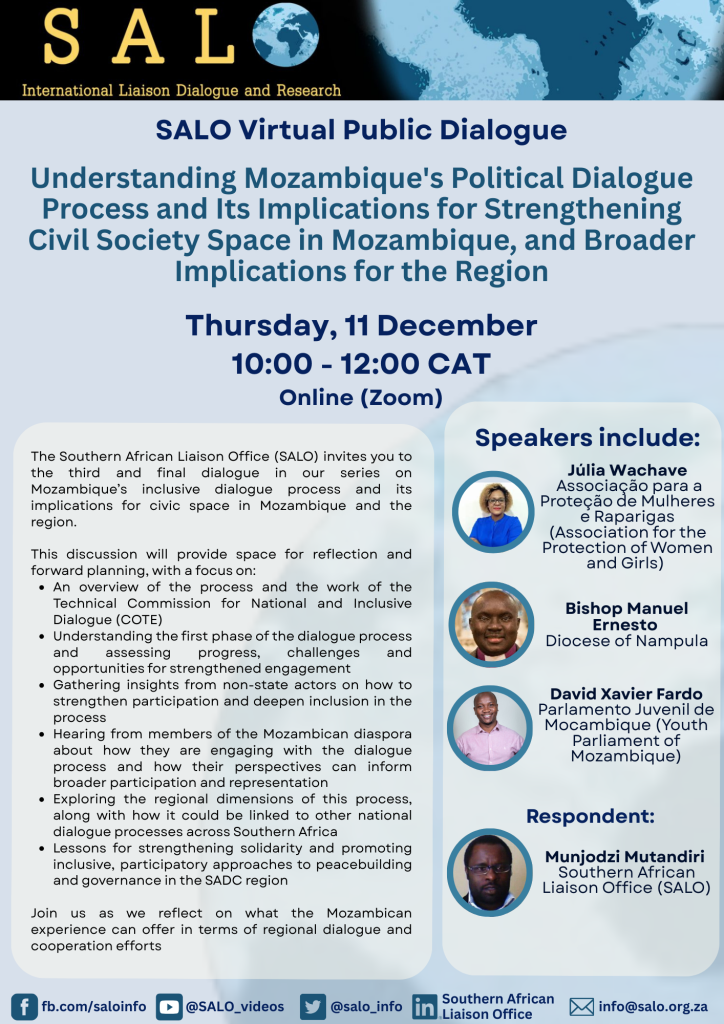
SALO Public Dialogue: Taking Stock of Mozambique’s National and Inclusive Dialogue Process – 11 Dec 2025
On 11 December 2025, the Southern African Liaison Office (SALO) convened a public dialogue focused on taking stock of Mozambique’s National and Inclusive Dialogue process as it stood toward the end of the year. The dialogue provided a space for reflection on progress made, challenges encountered, and the implications of the process for civic space, peacebuilding, and governance reform.
The engagement brought together Mozambican civil society actors, youth representatives, faith-based leaders, members of the diaspora, and regional observers to reflect on how the dialogue process has unfolded to date and what will be required to sustain momentum going forward.
Purpose of the Dialogue
The primary objective of the dialogue was to reflect on the trajectory of Mozambique’s National and Inclusive Dialogue process, with a view to assessing its credibility, inclusivity, and responsiveness to citizen concerns.
The discussion aimed to:
- Take stock of progress and challenges observed in the dialogue process to date
- Reflect on the experiences and expectations of civil society and non-state actors
- Consider what conditions are necessary to deepen participation and sustain reform momentum
The dialogue also sought to situate these reflections within a broader regional context, recognising the significance of Mozambique’s process for peace and governance debates in Southern Africa.
Key Areas of Discussion
Reflections on the Dialogue Process to Date
Participants reflected on the overall direction and tone of the National and Inclusive Dialogue, noting both positive developments and areas of concern. Contributors acknowledged the importance of creating structured spaces for political engagement, while emphasising that public confidence remains fragile.
Discussion highlighted the need for greater clarity around timelines, decision-making processes, and how public inputs are consolidated and advanced through subsequent phases of the dialogue.
Civil Society, Faith Actors, and Non-State Participation
The dialogue examined the experiences of civil society organisations, faith-based actors, and other non-state participants engaging with the process. Contributors highlighted the important role these actors play in facilitating community-level engagement, promoting dialogue at grassroots level, and articulating citizen concerns.
At the same time, participants noted ongoing challenges related to access, influence, and uneven participation, particularly for actors outside major urban centres.
Youth, Diaspora Voices, and Expectations for Change
Youth participation featured prominently in the dialogue, with speakers emphasising the urgency of addressing generational expectations around political accountability, inclusion, and socio-economic opportunity.
Diaspora perspectives also contributed to the discussion, highlighting both continued engagement with developments in Mozambique and questions around how external voices can constructively support national processes without displacing local agency.
Civic Space, Trust, and Confidence in Reform
Participants reflected on the relationship between civic space and trust in the dialogue process. Concerns were raised about the impact of political polarisation, fear, and restricted civic freedoms on public willingness to engage openly.
The dialogue underscored that trust-building requires visible commitments to rights protection, transparency, and responsiveness, and that confidence in the dialogue will ultimately depend on whether citizens see tangible movement toward reform.
Looking Ahead: Sustainability and Implementation
A forward-looking focus characterised much of the discussion. Participants stressed that dialogue outcomes must be accompanied by clear implementation pathways, institutional follow-through, and continued civic oversight.
Contributors cautioned that without sustained engagement beyond formal dialogue phases, there is a risk that public expectations may outpace delivery, undermining confidence in the process.
Format and Participation
The dialogue was structured in two parts. The first session featured inputs from invited speakers with experience in peacebuilding, civil society advocacy, and governance. The second session opened the floor to participants, enabling reflection, questions, and exchange among diverse stakeholders.
Speakers
The dialogue featured contributions from:
- Bishop Manuel Ernesto, Diocese of Nampula
- David Faro, President, Youth Parliament of Mozambique
- Tebogo Lekubu, Southern African Liaison Office
- Munjodzi Mutandiri, Southern African Liaison Office
Conclusion
The 11 December dialogue underscored that Mozambique’s National and Inclusive Dialogue remains a work in progress, shaped by both opportunity and uncertainty. While participants recognised the significance of the process, there was broad consensus that its long-term impact will depend on deepened inclusion, sustained civic engagement, and credible implementation of reform commitments.
SALO will continue to support reflective dialogue, regional learning, and citizen-centred approaches to peacebuilding and democratic governance as Mozambique navigates this important political moment.