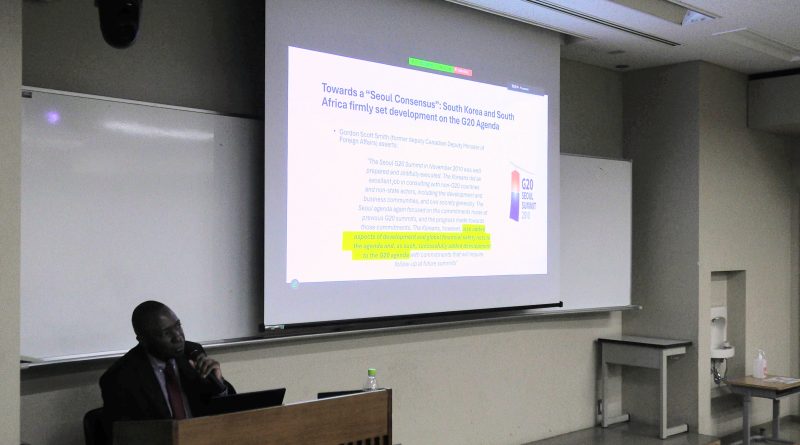
SALO’s Dr Tawanda Sachikonye presenting on South Africa’s 2025 G20 Presidency for the Africa Studies Center’s (ASC) 109th seminar 2025
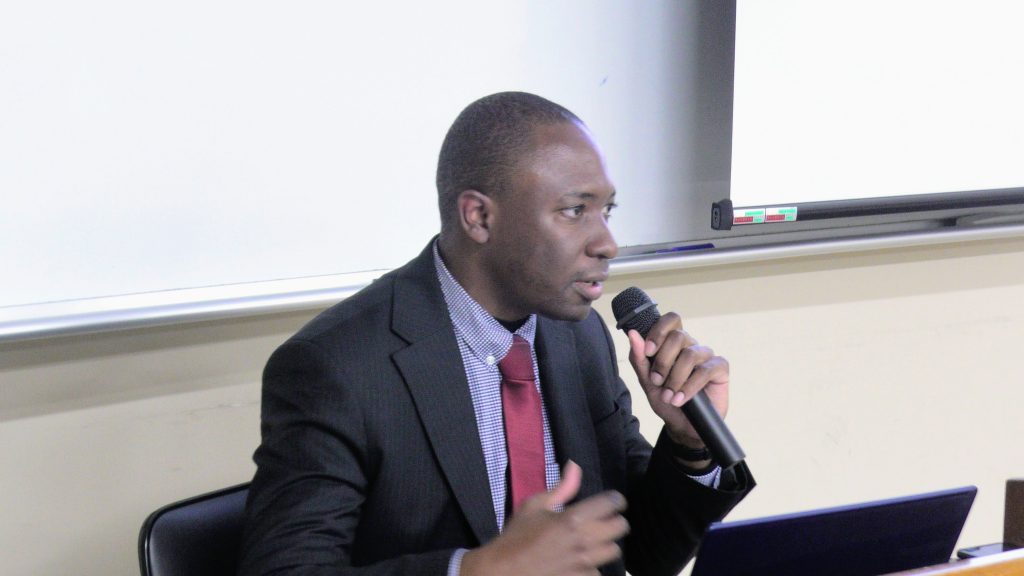
Dr Tawanda Sachikonye was invited to present on South Africa’s 2025 G20 Presidency for the Africa Studies Center’s (ASC) 109th seminar. The ASC is based at Tokyo’s University of Foreign Affairs, and is one of Japan’s premier African studies institutions. Dr Sachikonye’s presentation topic was “An African G20 or a G20 in Africa: A Preliminary Overview of South Africa’s G20 Presidency”. The seminar was chaired by Professor Chizuko Sato, who has conducted extensive academic research within South Africa and the SADC region.
Dr Sachikonye noted that the key legacy of South Africa’s G20 might be that South Africa (with the active support of the African Union) managed to host a ‘historic’ G20 Leaders’ Summit which highlighted Africa’s crucial role in global governance affairs. Furthermore, South Africa’s G20 underscored a strong affirmation for international mulitlateralism and cooperation between states and key regional groupings (such as the European Union and African Union), in a global context characterised by burgeoning unilateralism by powerful states. South Africa, in tandem with other African countries, managed to successfully advocate for the G20 to urgently address the issue of Africa and other developing countries’ unsustainable debt levels. Debt has become an impediment to transformative development in Africa. Therefore, it can be argued that through its G20 Presidency, South Africa managed to firmly place socioeconomic development concerns onto the G20 agenda, thereby highlighting South Africa’s commitment to the “African Developmental Agenda” which it has consistently supported since South Korea’s 2010 G20 Presidency, up to its recent Co-Chairship of the Compact with Africa (CWA) initiative with Germany. The United States’ unilateral opposition to South Africa’s G20 Presidency caused significant disruption and marred Africa’s first G20.
Dr Sachikonye noted that it is still too early to definitively ascertain what the outcome of the resolutions around debt sustainability such as the establishment of a “Borrowers Club” and International Monetary Fund (IMF) reforms might be. However, there appears to be a significant level of political will within the G20 to address these urgent issues. The key question going forward is whether the (delicate) gains made during South Africa’s G20 Presidency can be carried forward during America’s 2026 G20 Presidency.